Showing posts with label Personal Professional Development. Show all posts

Friday, 1 April 2016

Personal Professional Development

Personal Professional Development

Creating a creative CV

09/02/16

Idea's for a creative CV:

Standard creative CV:
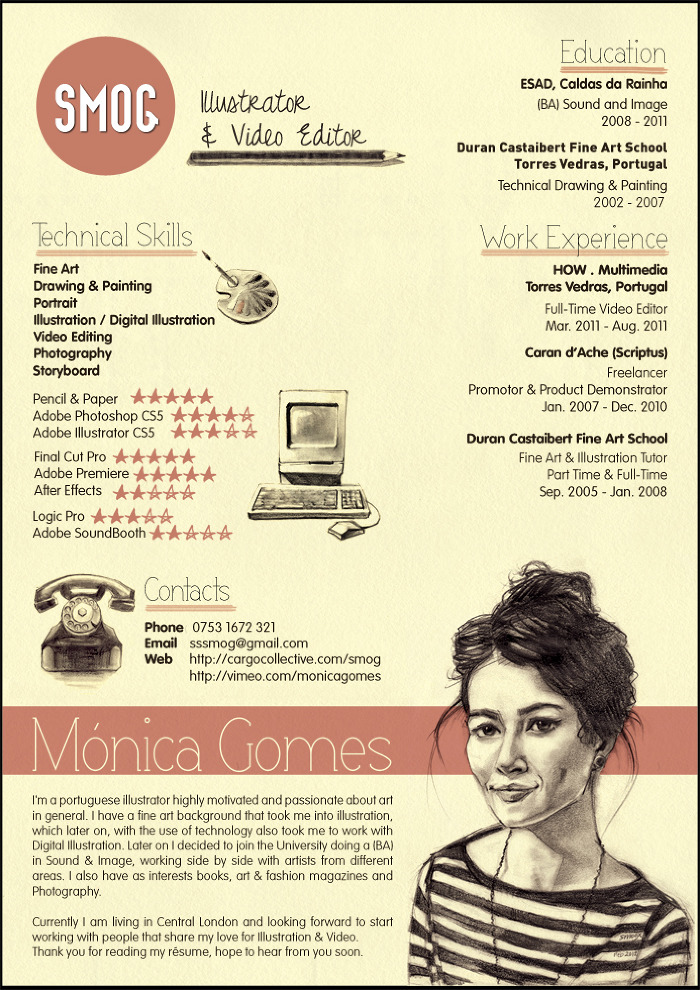
A creative and standard CV is in a simple format yet is still more creative and eye catching than a normal standard CV. It would be a paper based format and would still carry all of the necessary information that are required on a standard CV, however, the layout and design would be more thought out and more colourful.
A simple paper based creative CV needs to be clear and well thought out so that it isn't immediately dismissed by the employers who read them.
A CV for an Illustrator
A CV for someone in Advertising
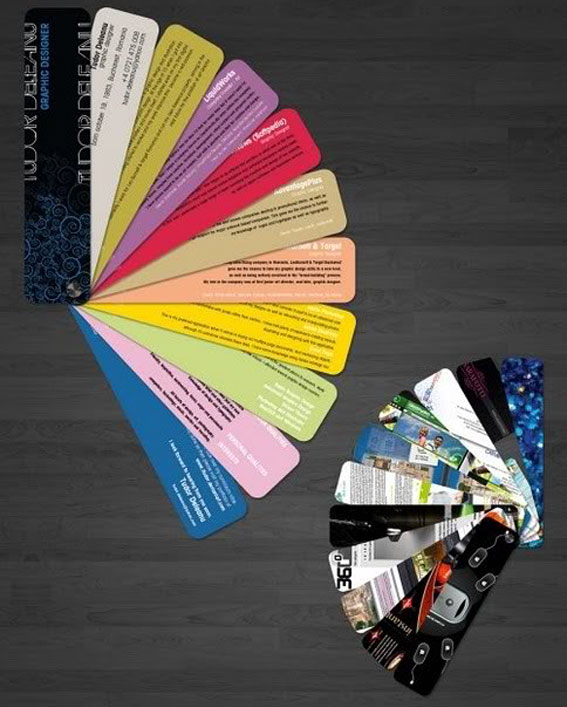
Flashcards:
The idea of having all of the necessary information in a small format that is easy to read and understandable is appealing because it is something that is well put together and also well organised. Rather than having simple flashcards, I would have bright colours and I would also experiment with the style of the format.

Tuesday, 9 February 2016

Personal Professional Development

Personal Professional Development

Future Plans

02/02/15


This unit allows us to look into professional environments as well as what we plan to do in the future. Since I am unclear and haven't made any solid plans, I will be using this unit to look into directions I may want to go, or have considered in the past or am considering.

Creating a CV:

Rather than making a standard CV, I am aiming to create one that would stand out, has everything necessary and also reflects who I am and what I am aiming to do. I want it to be relevant to the job or apprenticeship I am applying for. The more unique the better.

- A CV must be clear and easy to understand and get around.
- Don't overwork.
- Content and presentation will create impact.
- Get the content right before on the focusing the design.
- Eccentric CV's can put employers off.
- The best looking CV's will not get picked unless the content is also of value.
- A well designed CV would be expected from a design orientated student.
- Employers are most interested in content, practical skills and work experience.
- Employers are also interested in things such as exhibitions.
- Work experience is more important to educations to employers.
- Include technical skills (Photoshop etc)
- Provide a link on your CV to a website with examples of projects from your portfolio.


Looking into jobs and apprenticeships/ Work Experience:
 
Networking: Networking is essential when it comes to building up a presentation and getting known within the industry or through people who know others within the industry. It is simply talking to people and getting to know others.
Since I have neve thought seriously about going into further education, I thought it would be best to start looking for a job or apprenticeship in the creative sector. Currently, I am at a placement at a local Florist. I am there due to interest and for the knowledge of working in a creative environment professionally.


Wednesday, 20 January 2016

Mock FMP & Personal Professional Development

Mock FMP & Personal Professional Development


Research into fields of interest and artists in particular fields


24/11/15

Fashion Illustration

Sarah Beetson:


Nuno Dacosta:


Montana Forbes:


Jessica Singh:


Sunday, 15 November 2015

Personal Professional Development

Personal Professional Development


London: Visiting the UCAS Fair, The Tate Modern, The V&A, and The National History museum.


15/11/15


The trip to London was so that we could go to the HE fair, which is where all universities gather to promote and persuade. After this we went to various different museums, including the Tate Modern, The National History, The Victoria and Albert, and the National Science Museum, which I didn't get around to seeing. 

The UCAS Fair

The UCAS fair was extremely crowded and was lot different to what I expected. The building it was in was huge, as was the actual hall that the fair was placed in. It was especially crowded, and was very easy to loose the group you were walking around in, however it served it's purpose, as I learn a lot. 
The course that I was mainly asking around for was rather sparse, which I hadn't been expecting, however I did get a lot of information from other colleges that were highly beneficial, as well as a lot of free goodies. 


The Tate Modern

Out of all places I visited, this was my least favourite. I am not overly keen on the Tate for a start, since I am not drawn to modern art, but after visiting this particular tate gallery, my opinion changed even more from dislike to hatred for what is displayed as 'art'. I loved a lot of the pieces of artwork within the gallery, however, some pieces struck a chord with me.


It was this piece especially that I found to be annoying, and to me, offensive, since I cannot consider painting something one block colour art,

However, it was an especially boring exhibit, I feel, as there wasn't much that really grabbed my attention, aside from the mn outside that was creting bubbles and the spectacular view from one of the many floors the gallery had.


The National History Museum

Once again, this museum wasn't my favourite, but that is only because what it contained was not to my interests. It was enjoyable walking through and seeing huge models hanging from the ceiling, however, after a while. walking around the maze like museum just became boring. The actual building I found more interesting and spectacular.


The Victoria and Albert Museum

Definitely my favorite place out of all of the museums I visited. The place was awe inspiring and each room was more breathtaking than the last. My favorite rooms were definitely those that contained the huge casts, however it was closely followed by one of the first rooms which was full of statues, and then the numerous rooms that followed with different artifacts from different continents from across the globe. 


Overall it was a brilliant day, and considering it was my first time in London, I definitale want to go back so that I may look around more of the V&A and also look around the National Science museum, which I didn't see because I was out of time. But I would also like to look around the actual city properly, rather than sight-seeing out of a cramped couch window.

Personal Professional Developement

Personal Professional Development


Professional Practice Day at the Harley Gallery


07/10/15


The visit to the Harley Gallery this year was a lot different to last year, due to the fact that we had previously written a list of questions to ask each of the artists there, so as to get an idea of what it was actually like to work in a variety of different fields within the creative industry. I was most interested in the textiles artists and the Florist, since I am interested in fashion and floristry, but still paid close attention to what each of the different artists had to say about their careers.

Hope and Elvis: Textiles


At first didn't have any interest in doing textiles as a full time job, but later went to NNC to take a course in it. She has been in the Harley Gallery for almost 10 years, and even though she is a textiles artist, she isn't really a 'maker', but more of a 'teacher'.
It isn't something sustainable to live off of, as you don't make a lot of money, and is more of a hobby and lifestyle. It is a 24/7 job, whether she is in the studio or at home, since it is constantly on her mind, but is worth doing it in the long run. However, since it is a 24/7 job, the pleasure has been taken away because it is a job, something she has to do, rather than chooses to do, and because of this, she cannot do what she wants to do within the studio.

Richard Hartley: Guitar Maker


Originally a wood carver and a musician, he took a course in furniture restoration before deciding to move on to guitar making. He has been in this field for four years since, and has been working with wood for over 30 years. It is a very labor intensive and consuming process, taking up to 6 months for one guitar to be produced. It is all done by hand. All influence comes from Spanish Guitars in the 1850's. 
It would be a sustainable job if he had gone into the craft at an early age, but because it is such a labor intensive and time consuming craft, it is a dying trade. The guitars do sell, and for quite a bit, but with so little being produced, it doesn't equate to a sustainable lifestyle, however, he is happy with the way everything went. 

Ashley Thomas: Illustrator and Surface Pattern Designer


She had never always wanted to go into the illustrator, and was forced to become a freelance illustrator because of the recession. She wanted a secure job.
It wasn't a sustainable job at first, and first started working as an in house illustrator and designer. There are pro's and con's to working in the studio, and her experience has been a huge learning curve. Her work eventually became more commercial because it was more sustainable, and this way, she got a contract designing patterns for Debenhams. She constantly runs out of idea's, however she has to have idea's to get paid. It isn't an easy way of living , and it is mostly digital based.

J.A Alcock and Son: Clock Conservation and Restorer


Went into clock restoration after watching his dad fix an old grandfather clock, and eventually, taking apart and fixing clocks himself. He originally went into a corse of watch restoring, but found it want for him. The trade required problem solving skills and you need to be active. It is also something you have to enjoy doing. It can take anywhere between 2 days and months to repair a clock. It is another dying trade because no one wants to go into it. 
It is a reasonably sustainable job, for something you enjoy doing, as he had always wanted to go into the trade. 

Kyra Cane: Ceramicist


Originally, she used to teach, but then went into the trade. it is very hard to break free upon starting, yet is a sustainable craft. It is something that takes a long time to learn, and is something that isn't taught as much anymore. It is a very time consuming craft, however it is something that allows you to become extremely creative. You are constantly doing something from beginning to the end of the process. She is self employed and works through galleries. she also does a lot of commissions. 


Thoughts

Overall, I enjoyed this experience at the Harley galleries a lot more that I had in my first year of college because instead of just walking around uninterested, the task we had been set to gather questions meant that we were listening to the artists who worked there to gather our information, making a lot more interesting. I also visited a lot more different workshops, and avoided any artists who were overly negative so as to get the most positive experience possible. I learnt a lot and will take into account what I have been told. 

Friday, 2 October 2015

Personal Professional Development

Personal Professional Development


Further research into fields of interest


3/10/15


Jobs in Fashion Designing: £28,000 - £60,000 per annum

-Looks for experienced designers
For the role you need:
-A good eye for colour and shape
-To be able to draw and show design ideas effectively
-An interest in fashion, as well as past and future trends
-To have excellent technical skills in sewing and pattern making
-Artwork skills
-(Ideally) Digital illustration skills

Jobs in Fashion Photography: £50 per day (Events) £59,000 Average

For the role you need:
-To be dedicated to your career
-To operate efficiently under pressure
-To have deep and thorough knowledge of the fashion world
-To have outstanding creative and technical skills in photography
-To experiment and explore new ideas and techniques
-To have excellent communication skills
-To have excellent networking skills
-To be able to interpret and follow a brief in a highly creative way
-To be highly organized
-To be able to control studio or location situations, directing a full creative team
-To have good technical knowledge of photo-chemical and digital processes, and of all camera equipment
-To have an excellent sense of visual composition and perspective

Jobs in Dress Making: £29,000 - £45,000 Average

For the role you need:

-To have good practice in design skill
-To have excellent sewing skills
-To be interested in fashion
-To be able to visualize a design
-To be a good communicator
-To have a good eye for detail

Jobs in Costume Design: £18,000 - £85,000

For this role you need:

-To be creative and imaginative
-To have excellent design skill
-To have good communication skills
-To be skilled in research
-To know about costume history and modern fashion
-To have good stamina
-To be able to work good under pressure and strict deadlines
-To be highly organized
-To have to confidence to motivate a team
-To be able to put others at ease (when working closely with actors in a physical sense)
-To be able to break down scripts in terms of costume plots
-To know about story structure and character arcs
-To have good garment production skills and knowledge of textiles
-To have a wide ranging cultural knowledge base

Jobs in Illustration: £46,000 (25-34) £66,000 (35-44) £70.000 (55+)

For this role you need:

-To be able to discuss requirements or briefs with authors, editors or designers
-To negotiate prices and time scale
-To be able to decide on the right style for illustrations
-To be able to create illustrations using hand drawings, paintings or computer design packages
-To be able to speak with the client and make design changes if necessary
-To make sure the work is completed within set budgets and deadlines

Relevant degrees necessary: 
-Illustration
-Fine Art
-Graphic Design

Jobs in Make-Up and Hair Design: £12,000 - £38,000 (UK)

For this role you need:

-To possess hairdressing skills including: cutting, waving, straightening, non-permanent colouring, setting, applying extensions, braiding, wig setting/dressing/applying, shaving, applying/dressing facial hair
-To possess make-up skills including: Straight corrective, aging face/hands and neck, contouring effects, specialized effects such as creating tattoos and body painting
-To have a good eye for colour
-To have manual dexterity, necessary for to creation of hair and make-up styles and effects
-To have an understanding of the anatomy of the human skull and facial muscle structures
-To be able to break down scripts in terms of make-up and hair plots
-To be able to define the overall look of the production and re-create it.

Jobs in Prosthetics: £1500 - £3,000 per week

For this role you need:

-To be able to design, make and maintain special effects prosthetics make-up
-To be able to work with directors, make-up designers, production designers and actors
-To be able to work on feature films, television, commercials, pop promos and corporate productions
-To be able to understand how to translate abstract design ideas into practical applications
-To have creative flair and good craft skills, combined with a strong sense of colour and design
-To have a good understanding of anatomy, and have a talent for sculpting
-To be experiences in mould making, casting, part-casting, and removal procedures, and should understand how to join body sections together
-To have knowledge of industrial standard materials, such as foam, latex and silicone
-To be proficient in techniques such as face and body aging using prosthetics, and creating bald caps, false noses, scars, wounds, skin diseases and tattoos.
-To have good make-up application skills
-To have some understanding and experience with wigs
-To be tactful, sensitive, patient, and be able to put people and their ease
-To be physically fit to cope with many hours of standing or bending over actors
-To have good communication skills
-To have excellent organization skills
-To have good presentation skills
-To be able to work independently and as part of a team
-To be able to work under pressure to external and departmental deadlines
-To have good IT skills
-To understand relevant health and safety laws and procedures

Tuesday, 15 September 2015

Personal Professional Development

Personal Professional Development


Looking into fields of interest


15/09/15


This unit is all about developing skills and attributes that will help us get closer to a career in a desired fields of interest. It will help me to develop skills and knowledge.

Within this unit, I will:

-Present work to a range of audiences
-Set personal goals
-Compile a professional portfolio to support my progression

What I need to do within the unit:

-Explore a range of potential career opportunities
-Extend awareness of specific roles within the creative industry
-Look at what skills and attributes are required for specific roles
-Look at what qualifications are required
-Look at how to get there


Chief Make-up Artist/ Hair and Make-up Artist:
To create make-up nd hair that meets production requirements
Overseeing hair/ make-up continually
Working to a hair/ make-up brief

Dress Maker:
Producing made to measure clothing

Fashion Photographer:
Photographing garments and interpreting the underlying themes of the season, clothing range, designer or brand
For mail order catalogs, photographing the clothes to look as stylish as possible

Fashion Designer:
Designing items of clothing
Sketching designs by hand or through digital media
Making Patterns and samples

Illustrator:
Creating drawings, paintings and diagrams that make something more attractive or easier to understand
Drawings, paintings and diagrams could go into things such as books, book jackets greeting cards, packaging and detailed technical diagrams
Will need to follow a design brief, and will need good time management in order to meet client and publication deadlines

Prosthetic Artist:
Designing and maintaining special effects makeup
Working with directors, make-up artists, production designers and actors
Working on TV, Feature Films, commercials, pop promos and corporate productions.

Sculptor:
Designing and creating special features such as statues or complex props
Working closely with production designers and props management
Using a variety of different materials, such as polystyrene foam or clay, to transform design ideas into reality